NU Marine Design Decisions
A brief summary of key design choices made in 2026
Further details are provided in our technical design report
-
Validated baseline over ambitious capability. With limited man-hours and major rule changes for 2026, NU Marine chose simple, robust hardware. The aim was to maximize time in the water and air, since that is where software integration is actually proven.
One shared autonomy stack across all three vehicles. ROS 2 handles perception and coordination, and ArduPilot (via MAVLink) handles low-level control. Simulation and hardware use the same mission logic and interfaces, switched by a single use_sim launch flag. Tuned parameters from real vehicles load directly into SITL, so that simulation results more closely match physical hardware.
Behavior Tree mission director. The py_trees planner ticks at 10 Hz and coordinates the state/actions of each vehicle during mission tasks in order to achieve the goals set by our ground control station.
Gated testing pipeline. Every solution moves from simulation to workshop prototype (breadboard, 3D print, HITL) to on-water testing, and each stage must be demonstrated to leadership before the next. Water time is scarce because of administrative overhead, so iterative, cheap stages maximise the insights and value of real-world testing.
The USV as communications hub. Bastet tethers to Atlas's onboard PC, and Atlas relays to the UAV. This uses Atlas's GNSS position as a reference for the UUV but makes the surface vessel a single point of dependency.
-
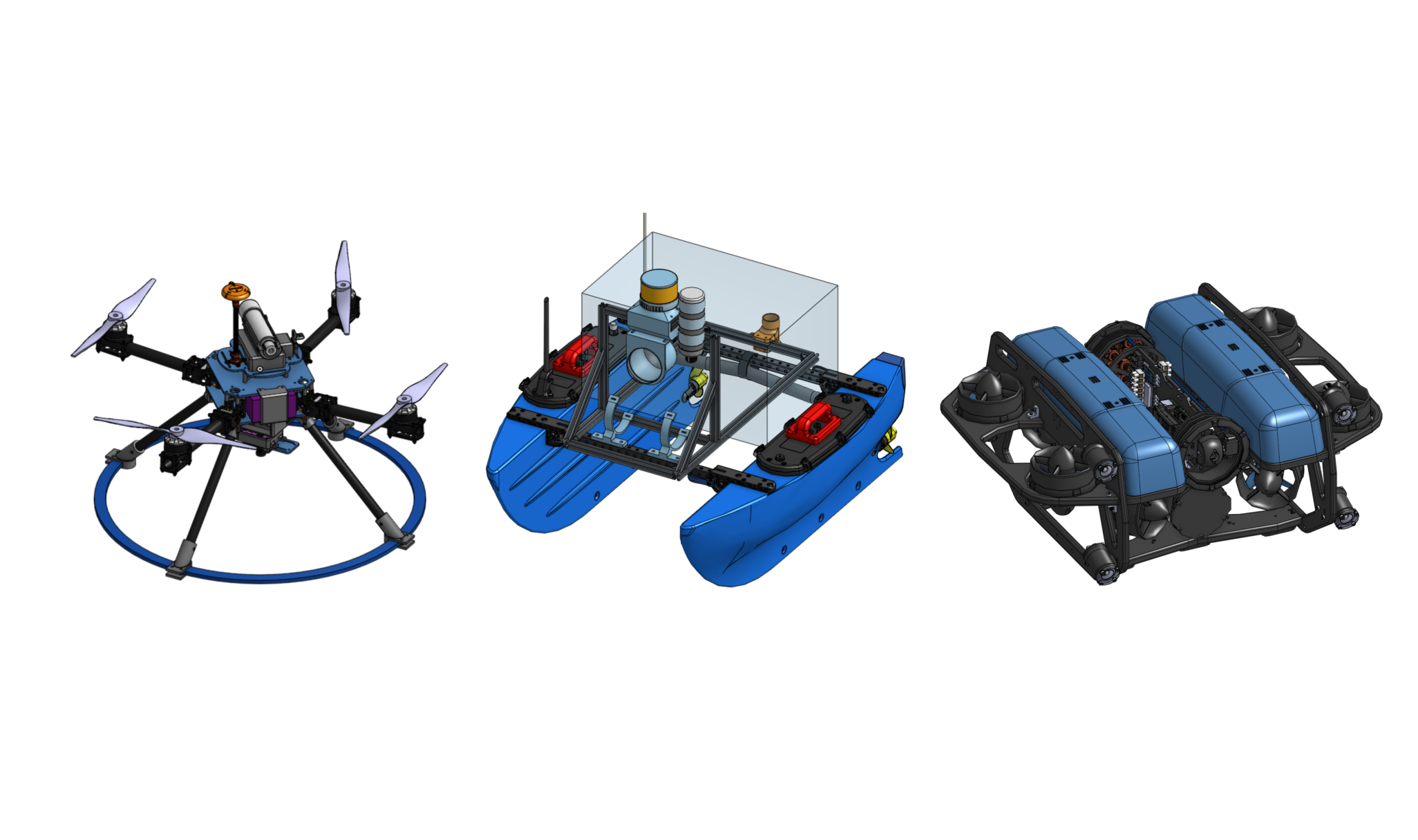
Minimal-scope hardware. Only the additions needed for perception and safety were made: propeller and rear guards for the twin thrusters, a light tower, a physical E-stop, and a sealed electronics enclosure. This limits new failure modes on a known platform.
Sensing architecture. A YOLO camera, a Hesai XT32 LiDAR, and an Advanced Navigation Spatial Dual sit on a rigid aluminium-extrusion mast that is independent of the hull. Both GNSS antennas are on the pontoons to maximize the baseline, which improves the dual-antenna heading solution.
Mapping. Camera classification is fused with LiDAR range and bearing, and buoys are stored as persistent landmarks anchored to the RTK-corrected global pose rather than to SLAM loop closure. This trades some generality for landmark accuracy that doesn't drift. A separate LiDAR occupancy grid feeds Nav2's costmap, so transient detections can't pollute the persistent course map.
Guidance. A Voronoi corridor map method finds corridors that obey the buoy rules of Mission Task 1. Hybrid A* and a path smoother then produce curvature-feasible paths, which are sent to ArduPilot as GUIDED waypoints. Keeping the rules in the roadmap search means the boat can't plan a path that is dynamically feasible but violates the rules.
-
Ground-up rebuild. Artemis was originally built using an off-the-shelf chassis, however, due to the need for replacement of parts after ground impacts, a significant mechanical overhaul was completed to strengthen key structural components and introduce more sacrificial components that would absorb impacts using in-house fabrication. This reduced repair downtime, enabling a more rapid testing and development cycle.
Extensive Tuning. Due to poor results from the use of autonomous flight tuning, NU Marine invested a significant amount of time into manual tuning from basic flight controller sensors to motor speed, axes of movement (roll, pitch, yaw) and finally PID controller tuning.
-
Off-the-shelf platform, targeted sensors. Bastet is a BlueROV2 with a Ping360 sonar and a new DVL A50. The DVL provides dead-reckoned motion relative to known positions, which is the essential sensor for autonomous movement underwater.
Tethered architecture. Tethering to the USV's PC provides GPS-derived reference positions and a communications path to the UAV. It sacrifices independence for integration simplicity, which suits a platform that has limited sensors that inform its flight controller’s state estimator.
Safety. The e-stop is a 3D-printed PETG collar holding a magnet on a rod. Pulling the rod trips a magnetic switch inside the enclosure that grounds the ESC PWM input and stops all thrust. This is a simple and mechanically reliable approach, which doesn’t require any external electronics to be waterproofed or any software to be running to safely halt the UUV.